
Dr. Tim Shaw
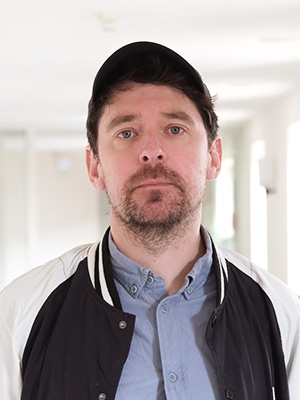
What does the theme “Conflict & Cooperation” mean to you?
As an artist, I am frequently cooperating with different individuals and institutions, whether other artists, scientists or universities. In past artistic projects I have collaborated with medieval musicologists, farmers, medical scientists, anthropologists, geologists, architects and astrophysicists. In these interdisciplinary projects there is often a tension (or a conflict) around what role artistic practice brings to other disciplines.
My engagement with Conflict & Cooperation is therefore primarily practical rather than purely theoretical, it is about finding meaningful ways to communicate across disciplinary boundaries, negotiating different ways of knowing and working productively within moments of friction.
In my experience, Conflict and Cooperation are not opposites, they are intertwined conditions of collaboration. Productive cooperation often emerges precisely through the negotiation of disagreement, difference or methodological tension.
In my artistic practice, I work extensively with sound, which is a particularly rich medium because it infiltrates nearly every aspect of our personal and professional lives, transcending cultural and linguistic divides. Sound does not stop at borders. It leaks, it resonates, it interferes and overlaps. In this sense, sound becomes a phenomenon to explore how conflict and cooperation coexist, how divisions are constructed, contested and sometimes dissolved through shared sensory experience.
How does this theme play a role in your work?
For over ten years I’ve been working artistically with sound in public space (through soundwalks, performances, installations and DIY listening technologies) exploring how listening can expose hidden social, political and technological tensions. I’m interested in how sound moves across boundaries. It doesn’t stop at borders or checkpoints; it overlaps and interferes. Through listening, Conflict and Cooperation stop only being political terms and become something you can actually sense: layered, simultaneous and entangled.
My custom soundwalking system Ambulation (https://tim-shaw.info/projects/ambulation/) is one way I explore this. It introduces technologically mediated listening into everyday environments, allowing participants to hear places through multiple sonic layers at the same time. Rather than simply documenting a space, the system attempts to respond to it, drawing attention to surveillance infrastructures, non-human activities, wildlife, informal economies and moments of shared presence that may otherwise go unnoticed. The DIY nature of much of the technology I use is also important, building and adapting tools becomes a way of questioning what is inside the 'black box' and proposing alternative, more participatory ways of engaging with technology.
My work with the Walking Festival of Sound (https://www.wfos.net/) (a festival I co-founded in 2019 with Jacek Smolicki) extends this into a broader public context. Bringing artists, researchers, activists and audiences together through shared listening experiences creating temporary communities formed through attention and encounter. In these spaces, cooperation happens through collective focus, while tensions surface through the histories, infrastructures and uneven politics embedded in the places we move through.
In a context like Basel (the meeting point of Switzerland, Germany, and France) these concerns feel especially present. “Soft” borders may seem seamless, but they are structured by economic, technological and political forces. Through performances, installations and mediated listening practices, I try to make these layered conditions audible and tangible, showing how infrastructures of control and everyday acts of exchange coexist in the same space.
What project(s) will you be working on during your fellowship at the Forum Basiliense?
During my fellowship I will develop Edge Cases, an artistic-research project that examines how listening practices and speculative media technologies can make tangible the mechanisms of conflict and cooperation in the border regions of Basel. I will begin by physically walking the tri-national border between Switzerland, Germany and France, following the borderline as closely as possible. I am a white man, I am aware that I am navigating these spaces from a privileged position.
Although borders appear as straight lines on a map, walking them reveals complex and messy territories shaped by negotiation, contradiction and everyday life. These edge-lands include informal architectures, allotments, forests, industrial zones, customs areas and leftover spaces where subtle surveillance infrastructures coexist with gardens, forests, radio towers, shopping centres, prisons and small cross-border economies. Through sustained walking, field recording and experimental forms of documentation, I will trace how these borderscapes twist unpredictably between rivers, houses and transport infrastructure, exposing the instability and improvisation that underpin so-called “soft” borders.
The project will also include the creation of soundwalks, DIY listening devices and experimental documentation that reveal the irregular routes and embodied detours of these territories. By experimenting with DIY sensing technologies and the idea of sousveillance, I aim to question the apparent precision of digital mapping and highlight how fragile and contingent these border systems are.
At its core, Edge Cases investigates how Conflict and Cooperation are not always opposites but entangled acoustic and spatial conditions, structured by infrastructures of power, yet continually reshaped by movement, ecology, economy and everyday acts of crossing.